

-
1 such *****
[sʌtʃ]1. predet, det1) (of this/that sort) tale, del generesuch a book — un tale libro, un libro del genere
such books — tali libri, libri del genere
it was such as to/that — era tale da/che
this is my car such as it is — questa è la mia macchina, se così si può chiamare
2) (so much, so great) tale, tanto (-a)I was in such a hurry that... — avevo così tanta fretta che...
such a lot of — talmente, così tanto (-a)
3) (so very) talmente, così4)such as — (introducing examples) come
such a man as you; a man such as you — un uomo come te
such writers as Updike; writers such as Updike — scrittori come Updike
hot countries such as India — paesi caldi, come l'India
2. pron1)(this, that, those)
such as wish to go — chi desidera andareI haven't many, but I'll give you such as I have — non ho molti, ma ti darò tutti quelli che ho
2)as such — (in that capacity) come tale, in quanto tale, (in itself) di per sé
he's not an expert as such, but... — non è un vero e proprio esperto, però...
doctors as such are... — i medici in quanto tali sono...
-
2 such
1. adjective, no compar. or superl.1) (of that kind) solch...such a person — solch od. (ugs.) so ein Mensch; ein solcher Mensch
such a book — solch od. (ugs.) so ein Buch; ein solches Buch
such things — so etwas
or some such thing — oder so etwas; oder etwas in der Art
you'll do no such thing — das wirst du nicht tun
there is no such bird — solch einen od. einen solchen Vogel gibt es nicht
experiences such as these — solche od. derartige Erfahrungen
I will take such steps as I think necessary — ich werde die Schritte unternehmen, die ich für notwendig halte
at such a moment as this — in einem Augenblick wie diesem; (disapproving) gerade jetzt
in such a case — in einem solchen od. (ugs.) so einem Fall
for or on such an occasion — zu einem solchen Anlass
such a one as he/she is impossible to replace — jemand wie er/sie ist unersetzlich
I got such a fright that... — ich bekam einen derartigen od. (ugs.) so einen Schrecken, dass...
such was the force of the explosion that... — die Explosion war so stark, dass...
3) with adj. so2. pronounshe has such lovely blue eyes — sie hat so schöne blaue Augen
as such — als solcher/solche/solches; (strictly speaking) im Grunde genommen; an sich
such as — wie [zum Beispiel]
* * *1. adjective1) (of the same kind as that already mentioned or being mentioned: Animals that gnaw, such as mice, rats, rabbits and weasels are called rodents; He came from Bradford or some such place; She asked to see Mr Johnson but was told there was no such person there; I've seen several such buildings; I've never done such a thing before; doctors, dentists and such people.) solch2) (of the great degree already mentioned or being mentioned: If you had telephoned her, she wouldn't have got into such a state of anxiety; She never used to get such bad headaches (as she does now).) derartig3) (of the great degree, or the kind, to have a particular result: He shut the window with such force that the glass broke; She's such a good teacher that the headmaster asked her not to leave; Their problems are such as to make it impossible for them to live together any more.) derartig4) (used for emphasis: This is such a shock! They have been such good friends to me!) solch2. pronoun(such a person or thing, or such persons or things: I have only a few photographs, but can show you such as I have; This isn't a good book as such (= as a book) but it has interesting pictures.) der/die/das, solch- academic.ru/71813/suchlike">suchlike- such-and-such
- such as it is* * *[sʌtʃ, sətʃ]I. adjI had never met \such a person before so [o geh solch] ein Mensch [o ein solcher Mensch] war mir noch nie begegnetI don't spend money on \such things für solche [o fam so] Dinge gebe ich kein Geld auspresent on this grand occasion were Andrew Davies, Melissa Peters and other \such stars bei diesem besonderen Anlass waren Andrew Davies, Melissa Peters und andere Stars dieser Größenordnung zugegenI have been involved in many \such courses ich habe [schon] viele Kurse dieser Art gemachthe said she had a cold, superior manner or some \such remark er sagte, sie sei kalt und überheblich, oder so etwas [o fam was] in der RichtungI tried to tell her in \such a way that she wouldn't be offended ich versuchte es ihr so zu sagen, dass sie nicht beleidigt warI'll show you \such books as I have ich zeige Ihnen, was ich an Büchern habein \such cases in solchen [o fam so] Fällen\such a thing so etwas [o fam was]I'm looking for a cloth for cleaning silver — do you have \such a thing? ich suche ein Tuch, mit dem man Silber putzen kann — führen Sie das?I said no \such thing so etwas habe ich nie gesagt, ich habe nie etwas Derartiges gesagtthere's no \such thing as ghosts so etwas wie Geister gibt es nicht2. (so great) solche(r, s), derartighe' \such an idiot! er ist so [o geh solch] ein Idiot!, er ist ein solcher [o derartiger] Idiot!why are you in \such a hurry? warum bist du so [o derart] in Eile?\such beauty is rare solche [o so viel] Schönheit ist selten3.II. pron1. (of that type) solche(r, s)we were second-class citizens and they treated us as \such wir waren Bürger zweiter Klasse und wurden auch so [o als solche] behandelt\such being the case... wenn das so ist,...\such is life so ist das Leben\such as it is so wie die Dinge liegen\such as it was, we had no alternative but to call our parents so wie die Dinge lagen, blieb uns nichts anderes übrig, als unsere Eltern anzurufenour lunch was \such that we don't really need an evening meal unser Mittagessen war so üppig, dass wir kein Abendessen brauchenthe wound was \such that... die Wunde war so groß, dass...\such is the elegance of his typeface that... seine Schrift ist so elegant, dass...\such as wiesmall companies \such as ours are very vulnerable in a recession Kleinunternehmen wie unseres sind äußerst rezessionsanfälligthat sum of money is to cover costs \such as travel and accommodation dieser Betrag soll Auslagen wie Reise- und Unterbringungskosten abdecken3. (suchlike) dergleichenwe talked about our kids, the weather and \such wir sprachen über unsere Kinder, das Wetter und Ähnliches [o dergleichen4. (strictly speaking)▪ as \such an [und für] sich, eigentlichwe don't have a secretary as \such wir haben eigentlich [o an [und für] sich] keine richtige Sekretärinthere was no vegetarian food as \such es gab kein eigentlich vegetarisches Essen5.▶ \such as it is:you're welcome to borrow my tennis racket, \such as it is du kannst dir gerne meinen Tennisschläger ausborgen — soweit er überhaupt noch viel taugtbreakfast, \such as it was, consisted of a couple of croissants and a cup of coffee das Frühstück, soweit vorhanden, bestand aus ein paar Croissants und einer Tasse Kaffeethe car, \such as it is, will get you to work auch wenn das Auto nicht mehr viel taugt, kannst du damit immer noch zur Arbeit fahrenshe's \such an arrogant person sie ist so [o dermaßen] arrogantthat's \such a good film das ist so ein [o ein wirklich] guter Film\such a big city! was für eine große Stadt!I've never had \such good coffee ich habe noch nie [einen] so guten Kaffee getrunkenit's \such a long time ago es ist [schon] so lange herto be \such a long way [away] so weit weg seinI'd put on \such a lot of weight that... ich hatte so [o dermaßen] viel zugenommen, dass...\such nice weather so schönes Wetterit was \such nice weather that... das Wetter war so schön, dass...\such that... so [o auf die Art]... dass...we still have to link the sentences \such that they constitute a narrative wir müssen die Sätze noch so verbinden, dass sie eine Erzählung ergeben* * *[sʌtʃ]1. adj1) (= of that kind) solche(r, s)such a person — so or solch ein Mensch, ein solcher Mensch
such a book — so ein Buch, ein solches Buch
such people/books — solche Leute/Bücher
many/few/all such people/books — viele/wenige/all solche Leute/Bücher
all such books are very expensive —
such a thing — so etwas, so was
have you got such a thing as...? there's such a thing as divorce — haben Sie so etwas wie...? es gibt so etwas wie eine Scheidung
I'll/you'll do no such thing — ich werde mich/du wirst dich hüten
... or some such idea —... oder so etwas,... oder so was in der Richtung (inf),... oder so ähnlich
... or some such name/place —... oder so (ähnlich)
he was such a one/just such another — er war einer von ihnen/auch (so) einer
men/books such as these, such men/books as these — Männer/Bücher wie diese, solche Männer/Bücher
writers such as Agatha Christie, such writers as Agatha Christie —
he's not such a fool as you think — er ist nicht so dumm, wie Sie denken
I'm not such a fool as to believe that or that I'd believe that — ich bin nicht so dumm or kein solcher Dummkopf, dass ich das glaube
such people as attended — die(jenigen), die anwesend waren
I'll give you such books/money as I have — was ich an Büchern/Geld habe, gebe ich Ihnen
2)(= so much, so great etc)
he's such a liar — er ist so or solch ein Lügner, er ist ein derartiger or solcher Lügnerhe did it in such a way that... — er machte es so, dass...
such wealth! — welch( ein) Reichtum!
3) predhis surprise was such that..., such was his surprise that... — seine Überraschung war so groß, dass..., er war so überrascht, dass...
his manner was such that... —
her speech was such that... — ihre Rede war so gehalten, dass...
4)See:2. advso, solch (geh)3. pronrabbits and hares and such — Kaninchen, Hasen und dergleichen
such being the case... —
such was not my intention — dies war nicht meine Absicht
such as it is — so, wie es nun mal ist
the food, such as there was of it... —
I'll give you such as I have — ich gebe Ihnen, was ich habe
* * *such [sʌtʃ]A adj1. solch(er, e, es), derartig(er, e, es):such a man ein solcher Mann;no such thing nichts dergleichen;there are such things so etwas gibt es oder kommt vor;such a life as they live ein Leben, wie sie es führen;such people as you see here die(jenigen) oder alle Leute, die man hier sieht;a system such as this ein derartiges System;such a one ein solcher, eine solche, ein solches;Mr such and such Herr Soundso;such and such persons die und die Personen2. ähnlich, derartig(er, e, es):such is life so ist das Leben;such as it is wie es nun einmal ist;such being the case da es sich so verhälthe got such a fright that … er bekam einen derartigen Schrecken, dass …;such was the force of the explosion so groß war die Gewalt der Explosion5. umg so gewaltig, solch:we had such fun! wir hatten (ja) so einen Spaß!B adv so, derart:such a nice day so ein schöner Tag;such a long time eine so lange ZeitC pron1. solch(er, e, es), der, die, das, die pl:a) diejenigen, welche; alle, die; solche, die,b) wie (zum Beispiel);such was not my intention das war nicht meine Absicht;man as such der Mensch als solcher;all such alle dieser Art;and such (like) und dergleichen2. umg oder WIRTSCH der-, die-, dasselbe, dieselben pl* * *1. adjective, no compar. or superl.1) (of that kind) solch...such a person — solch od. (ugs.) so ein Mensch; ein solcher Mensch
such a book — solch od. (ugs.) so ein Buch; ein solches Buch
or some such thing — oder so etwas; oder etwas in der Art
there is no such bird — solch einen od. einen solchen Vogel gibt es nicht
experiences such as these — solche od. derartige Erfahrungen
I will take such steps as I think necessary — ich werde die Schritte unternehmen, die ich für notwendig halte
at such a moment as this — in einem Augenblick wie diesem; (disapproving) gerade jetzt
in such a case — in einem solchen od. (ugs.) so einem Fall
for or on such an occasion — zu einem solchen Anlass
such a one as he/she is impossible to replace — jemand wie er/sie ist unersetzlich
2) (so great) solch...; derartigI got such a fright that... — ich bekam einen derartigen od. (ugs.) so einen Schrecken, dass...
such was the force of the explosion that... — die Explosion war so stark, dass...
3) with adj. so2. pronounas such — als solcher/solche/solches; (strictly speaking) im Grunde genommen; an sich
such as — wie [zum Beispiel]
* * *adj.derartig adj.solch adj.solcher adj.solches adj. -
3 such examples are to be found by the score
Общая лексика: можно найти десятки таких примеровУниверсальный англо-русский словарь > such examples are to be found by the score
-
4 such examples help, no doubt, but they also miss a basic point about ...
• такие примеры, без сомнения, помогают, но и они упускают важный момент...English-Russian dictionary of phrases and cliches for a specialist researcher > such examples help, no doubt, but they also miss a basic point about ...
-
5 such examples undermine N’s argument ...
• такие примеры подрывают доводы N...English-Russian dictionary of phrases and cliches for a specialist researcher > such examples undermine N’s argument ...
-
6 Other such examples
Программирование: Другие примеры -
7 many of such examples exist ...
• многие из таких примеров существуют...English-Russian dictionary of phrases and cliches for a specialist researcher > many of such examples exist ...
-
8 there are plenty of such examples ...
• имеется огромное количество таких примеров...English-Russian dictionary of phrases and cliches for a specialist researcher > there are plenty of such examples ...
-
9 Windows Sidebar
"An organizational feature of Windows that displays a panel on the side of the desktop with shortcuts to mini-applications, also known as gadgets. The examples of such gadgets are local weather, a photo slideshow, a dictionary, news headlines, and a Windows Media Player control." -
10 process related station level functions
- технологические функции станционного уровня системы автоматизации подстанции
технологические функции станционного уровня системы автоматизации подстанции
Функции, использующие данные более чем одного присоединения или всей подстанции и воздействующие на первичное оборудование более чем одного присоединения или на оборудование всей подстанции.
Примечание. Эти функции сообщаются в основном через логический интерфейс 8.
[ ГОСТ Р 54325-2011 (IEC/TS 61850-2:2003)]EN
process related station level functions
use data from more than one bay, or from the whole substation and act on the primary equipment of more than one bay, or on the primary equipment of the whole substation. Examples of such functions are: station wide interlocking, automatic sequencers, and busbar protection. These functions communicate mainly via the logical interface 8
[IEC 61850-2, ed. 1.0 (2003-08)]Тематики
EN
Англо-русский словарь нормативно-технической терминологии > process related station level functions
-
11 Little
I 1. ['lɪtl](compar. less; superl. least) quantisostantivo femminilelittle chance — poche o scarse possibilità
2.there's little sense o point non ha molto senso; he speaks little German parla poco il tedesco; with no little difficulty non senza difficoltà; I see little of Paul these days — in questi giorni vedo Paul molto di rado
it says very little for her — non depone molto a suo favore, non le fa molto onore
little or nothing — quasi nulla, praticamente niente
••little by little — poco a poco, poco per volta, gradualmente
••to make little of — (disparage) dare poca importanza a, non dare peso a [ victory]; (not understand) non capire molto, capirci poco di [ speech]
Note:When little is used as a quantifier ( little time, little hope, little money, little chance), it is translated by poco / poca / pochi / poche: poco tempo, poca speranza, pochi soldi, poche possibilità. For examples and particular usages, see I below. - When a little is used as a pronoun ( give me a little), it is translated by un po' or un poco: dammene un po' / un poco. - When little is used alone as a pronoun ( there is little I can do), it is very often translated non... un granché: non posso fare un granché. - For examples of these and other uses of little as a pronoun ( to do as little as possible etc.), see the entry below. - For uses of little and a little as adverbs, see the entry below. - Note that less and least are treated as separate entries in the dictionaryII ['lɪtl]1) (not much) [speak, eat, go] poco2) (scarcely)3) (not at all)4) a little (bit) (slightly) un po'a little less, more — un po' meno, un po' più
stay a little longer — rimani ancora un po' o un po' di più
5) as little asIII ['lɪtl]aggettivo (compar. less; superl. least) When little is used with nouns to express such qualities as smallness, prettiness or disparagement, Italian may convey the same meaning by means of suffixes that alter the sense of the noun: a little house = una casetta; a little old man = un vecchietto; my little brother = il mio fratellino; her little sister = la sua sorellina; little girl = ragazzina; a little hat = un cappellino; little Mary = Mariuccia; a nasty little man = un perfido ometto; a silly little woman = una stupida donnetta. - Please note that, although smaller and smallest are generally used instead of littler e littlest, the Italian translation does not change: più piccolo, il più piccolo1) (small) piccoloa little house — una piccola casa, una casetta
a little something — qualcosina, una cosina
2) (young) [sister, boy] piccolowhen I was little — quando ero piccolo, da piccolo
3) (feeble) [gesture, nod] piccoloa little voice said... — una vocina flebile disse
4) (lacking influence) [farmer, businessman] piccolo6) (short) [nap, holiday, break] breve* * *['litl] 1. adjective1) (small in size: He is only a little boy; when she was little (= a child).) piccolo2) (small in amount; not much: He has little knowledge of the difficulties involved.) poco3) (not important: I did not expect her to make a fuss about such a little thing.) piccolo, (poco importante)2. pronoun((only) a small amount: He knows little of the real world.) poco3. adverb1) (not much: I go out little nowadays.) poco2) (only to a small degree: a little-known fact.) poco3) (not at all: He little knows how ill he is.) (per niente)•- a little- little by little
- make little of* * *(Surnames) Little /ˈlɪtl/* * *I 1. ['lɪtl](compar. less; superl. least) quantisostantivo femminilelittle chance — poche o scarse possibilità
2.there's little sense o point non ha molto senso; he speaks little German parla poco il tedesco; with no little difficulty non senza difficoltà; I see little of Paul these days — in questi giorni vedo Paul molto di rado
it says very little for her — non depone molto a suo favore, non le fa molto onore
little or nothing — quasi nulla, praticamente niente
••little by little — poco a poco, poco per volta, gradualmente
••to make little of — (disparage) dare poca importanza a, non dare peso a [ victory]; (not understand) non capire molto, capirci poco di [ speech]
Note:When little is used as a quantifier ( little time, little hope, little money, little chance), it is translated by poco / poca / pochi / poche: poco tempo, poca speranza, pochi soldi, poche possibilità. For examples and particular usages, see I below. - When a little is used as a pronoun ( give me a little), it is translated by un po' or un poco: dammene un po' / un poco. - When little is used alone as a pronoun ( there is little I can do), it is very often translated non... un granché: non posso fare un granché. - For examples of these and other uses of little as a pronoun ( to do as little as possible etc.), see the entry below. - For uses of little and a little as adverbs, see the entry below. - Note that less and least are treated as separate entries in the dictionaryII ['lɪtl]1) (not much) [speak, eat, go] poco2) (scarcely)3) (not at all)4) a little (bit) (slightly) un po'a little less, more — un po' meno, un po' più
stay a little longer — rimani ancora un po' o un po' di più
5) as little asIII ['lɪtl]aggettivo (compar. less; superl. least) When little is used with nouns to express such qualities as smallness, prettiness or disparagement, Italian may convey the same meaning by means of suffixes that alter the sense of the noun: a little house = una casetta; a little old man = un vecchietto; my little brother = il mio fratellino; her little sister = la sua sorellina; little girl = ragazzina; a little hat = un cappellino; little Mary = Mariuccia; a nasty little man = un perfido ometto; a silly little woman = una stupida donnetta. - Please note that, although smaller and smallest are generally used instead of littler e littlest, the Italian translation does not change: più piccolo, il più piccolo1) (small) piccoloa little house — una piccola casa, una casetta
a little something — qualcosina, una cosina
2) (young) [sister, boy] piccolowhen I was little — quando ero piccolo, da piccolo
3) (feeble) [gesture, nod] piccoloa little voice said... — una vocina flebile disse
4) (lacking influence) [farmer, businessman] piccolo6) (short) [nap, holiday, break] breve -
12 business letter format
бизн. формат делового письма, формат служебного письма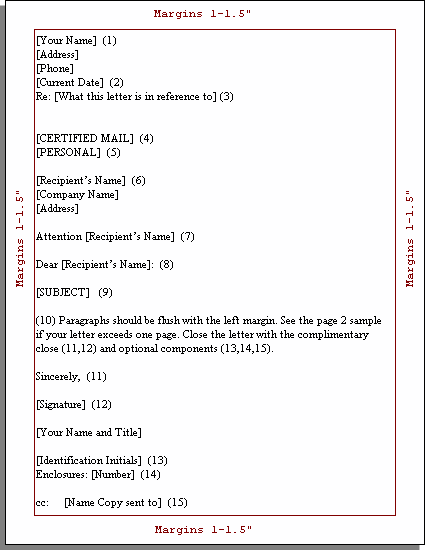 Комментарии к формату (см. рис.)If your stationery includes a letterhead, skip this block. Type your name and address along with other relevant contact information such as e-mail or fax number.If your stationery includes a letterhead, type the date from 2 to 6 lines under the letterhead. Otherwise type it under the return address.Use this block to identify what the letter is in regards to. Examples are: "Re: Invoice 12345" or "Re: Your letter dated January 15, 2010.".Always in caps. Examples include SPECIAL DELIVERY, CERTIFIED MAIL, AIRMAIL, VIA FACSIMILE.Notation on private correspondence if needed such as PERSONAL or CONFIDENTIAL. This goes just above the recipient.Type the name and address of the person and / or company. If you are using an attention line (block 7) then skip the person's name. Address the envelope similarly.Type the name of the personType the recipient's name. Use Mr. or Ms. [Last Name] to show respect, but don't try to guess spelling or gender if you are not sure. Some common salutations are: "Dear [Full Name]:", "To Whom it May Concern:".Type a short description on what the letter is about. If you used a reference line, then you likely do not need a subject line.Type two spaces between sentences.Completing the LetterIt depends on the tone and degree of formality as to what you write here. Can vary from the very formal "Respectfully yours" to the typical "Sincerely" to the friendly "Cordially yours".Leave four blank lines after the Complimentary Close (block 11) to sign your name. Type your name and (optional) title under that signature.If someone else has typed the letter for you, it is common for them to indicate so with initials. Typically it is your initials in upper case followed by the other initials in lower case. For example "BCT/gt". If you typed your own letter, skip this block.If you are including other things with the letter such as brochures, this line tells the reader how many to expect. Common styles include "Enclosures: 3".If you are distributing copies of the letter to others, indicate so using a copies block. the code "cc:" used to indicate carbon copies but now is commonly called courtesy copies.Don't type the brackets. The brackets [ ] in the examples are for narrative purposes only.Try to keep your letters to one page.Use letterhead only for the first page. Just use a blank sheet of paper for continuation pages.You have some freedom in how many blank lines to use between blocks and in the margin sizes in order to fit a letter onto a single page.Not all letters need every block identified in this article. If you leave one out, do not leave blank lines where the blocks would have been.
Англо-русский универсальный дополнительный практический переводческий словарь И. Мостицкого > business letter format
-
13 Down
I [daʊn]to go down — andare giù, scendere
to fall down — cadere (giù), crollare
is Tim down yet? — (from upstairs) è già sceso Tim?
"down" — (in crossword) "verticali"
down below — giù, in basso; (when looking down from height) laggiù
two floors down — due piani sotto o più giù
they live down south — colloq. vivono nel Sud
4) (in a range, scale, hierarchy)5) (indicating loss of money etc.)bookings are down by a half — le prenotazioni si sono dimezzate, sono diminuite della metà
profits are well down on last year's — i profitti sono nettamente inferiori a quelli dell'anno scorso
to get one's weight down — dimagrire, perdere peso
that's seven down, three to go! — fatti sette o via sette, ne restano tre!
7) (on list, schedule)I've got you down for Thursday — (in appointment book) le ho fissato un appuntamento per giovedì
to be down with the flu — avere l'influenza, essere a letto con l'influenza
9) sportto be two sets down — [ tennis player] essere in svantaggio di due set
10) (as deposit)11) (downwards)face down — a faccia in giù o prono
••••Note:Down often occurs as the second element in verb combinations in English ( go down, fall down, get down, keep down, put down etc.). For translations, consult the appropriate verb entry (go, fall, get, keep, put etc.). - When used after such verbs as sit or lie, down implies the action being done. Compare the following examples and their translations: she is sitting = lei siede / è seduta; she is sitting down = lei si siede / si sta sedendo. - For examples and further usages, see the entry belowII [daʊn]3) (along)4) (throughout)III [daʊn]1) colloq.to feel down — sentersi giù, a terra
3) inform. fuori uso, guastoIV [daʊn]verbo transitivo colloq.2) (drink)V [daʊn]he downed his beer — si è scolato o ha tracannato la sua birra
VI [daʊn]to have a down on sb. — colloq. avercela con qcn
1) (of birds) piumino m.2) (of body, plants) lanugine f., peluria f.* * *I 1. adverb1) (towards or in a low or lower position, level or state: He climbed down to the bottom of the ladder.)2) (on or to the ground: The little boy fell down and cut his knee.)3) (from earlier to later times: The recipe has been handed down in our family for years.)4) (from a greater to a smaller size, amount etc: Prices have been going down steadily.)5) (towards or in a place thought of as being lower, especially southward or away from a centre: We went down from Glasgow to Bristol.)2. preposition1) (in a lower position on: Their house is halfway down the hill.)2) (to a lower position on, by, through or along: Water poured down the drain.)3) (along: The teacher's gaze travelled slowly down the line of children.)3. verb(to finish (a drink) very quickly, especially in one gulp: He downed a pint of beer.)- downward- downwards
- downward
- down-and-out
- down-at-heel
- downcast
- downfall
- downgrade
- downhearted
- downhill
- downhill racing
- downhill skiing
- down-in-the-mouth
- down payment
- downpour
- downright 4. adjectiveHe is a downright nuisance!) assoluto- downstream
- down-to-earth
- downtown
- downtown
- down-trodden
- be/go down with
- down on one's luck
- down tools
- down with
- get down to
- suit someone down to the ground
- suit down to the ground II noun(small, soft feathers: a quilt filled with down.)- downie®- downy* * *(Place names) Down /daʊn/* * *I [daʊn]to go down — andare giù, scendere
to fall down — cadere (giù), crollare
is Tim down yet? — (from upstairs) è già sceso Tim?
"down" — (in crossword) "verticali"
down below — giù, in basso; (when looking down from height) laggiù
two floors down — due piani sotto o più giù
they live down south — colloq. vivono nel Sud
4) (in a range, scale, hierarchy)5) (indicating loss of money etc.)bookings are down by a half — le prenotazioni si sono dimezzate, sono diminuite della metà
profits are well down on last year's — i profitti sono nettamente inferiori a quelli dell'anno scorso
to get one's weight down — dimagrire, perdere peso
that's seven down, three to go! — fatti sette o via sette, ne restano tre!
7) (on list, schedule)I've got you down for Thursday — (in appointment book) le ho fissato un appuntamento per giovedì
to be down with the flu — avere l'influenza, essere a letto con l'influenza
9) sportto be two sets down — [ tennis player] essere in svantaggio di due set
10) (as deposit)11) (downwards)face down — a faccia in giù o prono
••••Note:Down often occurs as the second element in verb combinations in English ( go down, fall down, get down, keep down, put down etc.). For translations, consult the appropriate verb entry (go, fall, get, keep, put etc.). - When used after such verbs as sit or lie, down implies the action being done. Compare the following examples and their translations: she is sitting = lei siede / è seduta; she is sitting down = lei si siede / si sta sedendo. - For examples and further usages, see the entry belowII [daʊn]3) (along)4) (throughout)III [daʊn]1) colloq.to feel down — sentersi giù, a terra
3) inform. fuori uso, guastoIV [daʊn]verbo transitivo colloq.2) (drink)V [daʊn]he downed his beer — si è scolato o ha tracannato la sua birra
VI [daʊn]to have a down on sb. — colloq. avercela con qcn
1) (of birds) piumino m.2) (of body, plants) lanugine f., peluria f. -
14 down
I [daʊn]to go down — andare giù, scendere
to fall down — cadere (giù), crollare
is Tim down yet? — (from upstairs) è già sceso Tim?
"down" — (in crossword) "verticali"
down below — giù, in basso; (when looking down from height) laggiù
two floors down — due piani sotto o più giù
they live down south — colloq. vivono nel Sud
4) (in a range, scale, hierarchy)5) (indicating loss of money etc.)bookings are down by a half — le prenotazioni si sono dimezzate, sono diminuite della metà
profits are well down on last year's — i profitti sono nettamente inferiori a quelli dell'anno scorso
to get one's weight down — dimagrire, perdere peso
that's seven down, three to go! — fatti sette o via sette, ne restano tre!
7) (on list, schedule)I've got you down for Thursday — (in appointment book) le ho fissato un appuntamento per giovedì
to be down with the flu — avere l'influenza, essere a letto con l'influenza
9) sportto be two sets down — [ tennis player] essere in svantaggio di due set
10) (as deposit)11) (downwards)face down — a faccia in giù o prono
••••Note:Down often occurs as the second element in verb combinations in English ( go down, fall down, get down, keep down, put down etc.). For translations, consult the appropriate verb entry (go, fall, get, keep, put etc.). - When used after such verbs as sit or lie, down implies the action being done. Compare the following examples and their translations: she is sitting = lei siede / è seduta; she is sitting down = lei si siede / si sta sedendo. - For examples and further usages, see the entry belowII [daʊn]3) (along)4) (throughout)III [daʊn]1) colloq.to feel down — sentersi giù, a terra
3) inform. fuori uso, guastoIV [daʊn]verbo transitivo colloq.2) (drink)V [daʊn]he downed his beer — si è scolato o ha tracannato la sua birra
VI [daʊn]to have a down on sb. — colloq. avercela con qcn
1) (of birds) piumino m.2) (of body, plants) lanugine f., peluria f.* * *I 1. adverb1) (towards or in a low or lower position, level or state: He climbed down to the bottom of the ladder.)2) (on or to the ground: The little boy fell down and cut his knee.)3) (from earlier to later times: The recipe has been handed down in our family for years.)4) (from a greater to a smaller size, amount etc: Prices have been going down steadily.)5) (towards or in a place thought of as being lower, especially southward or away from a centre: We went down from Glasgow to Bristol.)2. preposition1) (in a lower position on: Their house is halfway down the hill.)2) (to a lower position on, by, through or along: Water poured down the drain.)3) (along: The teacher's gaze travelled slowly down the line of children.)3. verb(to finish (a drink) very quickly, especially in one gulp: He downed a pint of beer.)- downward- downwards
- downward
- down-and-out
- down-at-heel
- downcast
- downfall
- downgrade
- downhearted
- downhill
- downhill racing
- downhill skiing
- down-in-the-mouth
- down payment
- downpour
- downright 4. adjectiveHe is a downright nuisance!) assoluto- downstream
- down-to-earth
- downtown
- downtown
- down-trodden
- be/go down with
- down on one's luck
- down tools
- down with
- get down to
- suit someone down to the ground
- suit down to the ground II noun(small, soft feathers: a quilt filled with down.)- downie®- downy* * *down (1) /daʊn/n.● (geogr.) the Downs, la rada di Deal □ (geogr.) the South Downs, le colline gessose nel sud dell'Inghilterra.down (2) /daʊn/n. [u]2 [u] lanugine; peluria♦ down (3) /daʊn/A avv. e a. pred.1 giù: Put that book down, metti giù quel libro; They held him down, lo hanno tenuto giù (o a terra); He had his head down, teneva la testa giù; stava a capo chino; The flap of this envelope won't stay down, il lembo di questa busta non vuole star giù; to lie face down, giacere a faccia in giù; Keep down!, sta' giù!; He's awake, but not down yet, è sveglio, ma non è ancora sceso ( dalla sua camera); The blinds were down, le tapparelle erano giù (o abbassate); Her hair was down, aveva i capelli sciolti ( sulle spalle); The river is down, il fiume è in stanca, l'acqua del fiume è bassa; The sun was already down below the horizon, il sole è già sceso sotto la linea dell'orizzonte; The tide is down, la marea è calata; Get down off the table!, scendi giù dal tavolo!; He crouched down behind a bush, si è accovacciato dietro un cespuglio; They swam down to look at the wreck, sono scesi a nuoto per vedere il relitto; to fly from Inverness down to London, scendere in aereo da Inverness a Londra; He gulped down his coffee, ha trangugiato il caffè2 ( di cifra, valore) – to be down, essere sceso: ( sport) The gap is down to 20 seconds, il ritardo è sceso a 20 secondi; Unemployment is down by 3%, la disoccupazione è scesa del 3%; Exports are down to an all-time low, le esportazioni sono scese al minimo storico; Gold is down ( in price), l'oro è in ribasso; The Dow was down more than 50 points on yesterday, il Dow Jones ha perso 50 punti nel corso della giornata di ieri3 – to be down, essere sotto (fig.); ( anche sport) essere in svantaggio; ( nelle corse) essere in ritardo: (autom.) to be two laps down, essere in ritardo di due giri; The gambler was 10,000 dollars down, il giocatore era sotto di 10 000 dollari; They were three goals down with four minutes left to play, erano sotto di tre reti, con appena quattro minuti ancora da giocare; Two down at half time, we eventually won 4-2, in svantaggio di due gol alla fine del primo tempo, alla fine abbiamo vinto per 4 a 24 (comm.) come acconto: Five hundred dollars down and the remainder in instalments, un acconto di cinquecento dollari e il resto a rate5 per iscritto: to be [to get st.] down on paper, essere [mettere qc.] per iscritto; Write this number down, annotati questo numero; I took down the details of the job, mi sono scritto i dati relativi al lavoro6 in lista: Put me ( o my name) down for ten pounds, mettimi in lista per dieci sterline; Are you down for the football team?, sei in lista per la squadra di calcio?; I'm down for the late shift on Friday, mi hanno messo nell'ultimo turno venerdì7 giù (di morale); depresso: I'm feeling a bit down today, oggi mi sento un po' giù (di morale); He was very down after failing his exam, era molto giù dopo essere stato bocciato all'esame8 a partire dall'alto: You'll find it in the third drawer down, lo troverai nel terzo cassetto a partire dall'alto10 ( di un apparecchio, ecc.) fuori uso (o inattivo): My computer is down, il mio computer è fuori uso; All the phone lines are down, tutte le linee telefoniche sono inattive11 (fam.) a letto: to go (o to come) down with flu, finire a letto con l'influenza; He's down with flu, è a letto con l'influenza13 (idiom., per es.:) Nail the lid down!, inchioda il coperchio!; We went down to Sicily, siamo andati in Sicilia; When are you coming down for the weekend?, quando vieni a passare qui un fine settimana?; He's just gone down to the post office, è appena andato alla posta; I saw her down by the river, l'ho vista in riva al fiume; down at the end of the street, in fondo alla strada14 ( in alcune università ingl.) ( di un docente) non in servizio, in sabbatico; ( di uno studente) in vacanza; ( anche) espulso15 ( sport) ( della palla) fuori gioco; ( baseball: di un giocatore) eliminato; ( cricket: del wicket) abbattuto17 (nei verbi frasali, è idiom.; per es.:) to go down, andare giù; scendere; tramontare; ecc.; to come down, venire giù; to get sb. down, deprimere q.; ecc. (► to go, to come; to get; ecc.) NOTA D'USO: - up to o down to?-B inter.1 giù!; a terra!● (naut.) to be down by the head, essere appruato □ (naut.) to be down by the stern, essere appoppato □ (in USA) Down-Easter, abitante della Nuova Inghilterra (spec. del Maine) □ ( boxe) to be down for the count, subire il conteggio totale; essere contato fino a 10 □ ( boxe) to be down for a count of 8, essere contato fino a 8 □ down here, qui attorno; da queste parti □ (fam.) to be down in the mouth, essere abbattuto (o triste, scoraggiato) □ (fam.) to be down on sb., avercela con q.: She's been down on me since I criticized her work, ce l'ha con me da quando ho criticato il suo lavoro □ to be down on one's luck, attraversare un brutto periodo; essere messo male ( a soldi) □ to be down to sb., spettare (o toccare) a q.: It's down to you to find out a solution to the problem, tocca a te trovare una soluzione al problema □ to be down to st., essere dovuto a (o causato da) q.: The crash was thought to be down to fog, si riteneva che l'incidente fosse dovuto alla nebbia □ to be down to one's last st. –: By the end of the week I was down to my last five pounds, alla fine della settimana mi erano rimaste le ultime cinque sterline □ to put st. down to st., attribuire (la causa di) qc. a qc.: He put her symptoms down to tiredness, attribuiva i suoi sintomi alla stanchezza □ down south, giù nel sud □ down there, laggiù □ down to, fino a: Everything was planned down to the last detail, era tutto pianificato fino all'ultimo dettaglio; Her dress came down to her ankles, il vestito le arrivava alle caviglie; from the wealthiest aristocrat down to the poorest beggar, dal più ricco degli aristocratici al più povero dei mendicanti □ down-to-earth, ( di persona) realista, pratico; coi piedi per terra (fam.); ( di un progetto, ecc.) realistico, concreto □ (fam.) down to the ground, completamente; del tutto: This job suits her down to the ground, questo lavoro è assolutamente perfetto per lei □ (fam.) down under, dall'altra parte del mondo; agli antipodi; in Australia (o in Nuova Zelanda) □ down with, abbasso: Down with the dictator!, abbasso il dittatore! □ to come down to earth, tornare con i piedi per terra (fig.); aprire gli occhi (fig.) □ Three down, and four to go, tre sono fatti, e quattro (ancora) da fare.down (4) /daʊn/a. attr.(che va) in giù, verso il basso; rivolto in basso: a down escalator, una scala mobile che scende; a down arrow, una freccia in giù● down-and-dirty, nudo e crudo: down-and-dirty rock, rock nudo e crudo; to get down-and-dirty with sb., scoprire gli altarini di q. □ (ingl.) down draught, ( USA) down draft, corrente d'aria discendente □ (comm.) down payment, acconto □ (ferr.) down platform, marciapiede di partenza (o d'arrivo) di un «down train» □ down shaft ► downcast (2) □ a down train, un treno che dalla città principale (per es., Londra) porta in provincia.♦ down (5) /daʊn/prep.1 giù per; a valle di: She ran down the stairs, è corsa giù per le scale; to walk down a hill, andare giù per un colle; discendere un colle; down the drain, giù per il tubo di scarico; to sail down a river, navigare giù per (o verso la foce di) un fiume; scendere un fiume; The village is a few miles down the Thames, il villaggio è a qualche miglia scendendo il Tamigi2 lungo; per: down the corridor, lungo il corridoio; Her hair was hanging down her back, i capelli le scendevano lungo la schiena; He was running down the street, correva per la strada● down the left ( hand side), sulla sinistra; sul fianco (o sul lato) sinistro: A run down the left put him in a position to shoot, con una corsa sulla sinistra si è ritrovato in posizione di tiro □ (fam. USA) down the line, in linea gerarchica; facendo tutta la scala (fig.); ( anche) nei quartieri malfamati ( di una città) □ down the right ( hand side), sulla destra; sul lato (o sul fianco) destro □ down the road, più giù lungo la strada; (fig.) nel futuro: They live just down the road, abitano in questa strada, un po' più giù: How do you see yourself five years down the road?, come ti vedi nei cinque anni a venire? □ to get st. down in one, ingoiare (o buttare giù) qc. tutto d'un colpo □ to go down the pan (o the tubes), andare a farsi friggere: The whole project has gone down the pan, tutto il progetto è andato a farsi friggere.down (6) /daʊn/n.● (fam.) to have a down on sb., provare avversione (o antipatia) per q.; avercela con q.(to) down /daʊn/v. t. (fam.)1 trangugiare, scolarsi (fam.): to down a bottle of wine, scolarsi una bottiglia di vino: He downed his hot dog in three bites, ha trangugiato il suo hot dog in un paio di bocconi3 abbattere; atterrare● to down tools, incrociare le braccia; scioperare; ( di un sindacato) proclamare lo sciopero.* * *I [daʊn]to go down — andare giù, scendere
to fall down — cadere (giù), crollare
is Tim down yet? — (from upstairs) è già sceso Tim?
"down" — (in crossword) "verticali"
down below — giù, in basso; (when looking down from height) laggiù
two floors down — due piani sotto o più giù
they live down south — colloq. vivono nel Sud
4) (in a range, scale, hierarchy)5) (indicating loss of money etc.)bookings are down by a half — le prenotazioni si sono dimezzate, sono diminuite della metà
profits are well down on last year's — i profitti sono nettamente inferiori a quelli dell'anno scorso
to get one's weight down — dimagrire, perdere peso
that's seven down, three to go! — fatti sette o via sette, ne restano tre!
7) (on list, schedule)I've got you down for Thursday — (in appointment book) le ho fissato un appuntamento per giovedì
to be down with the flu — avere l'influenza, essere a letto con l'influenza
9) sportto be two sets down — [ tennis player] essere in svantaggio di due set
10) (as deposit)11) (downwards)face down — a faccia in giù o prono
••••Note:Down often occurs as the second element in verb combinations in English ( go down, fall down, get down, keep down, put down etc.). For translations, consult the appropriate verb entry (go, fall, get, keep, put etc.). - When used after such verbs as sit or lie, down implies the action being done. Compare the following examples and their translations: she is sitting = lei siede / è seduta; she is sitting down = lei si siede / si sta sedendo. - For examples and further usages, see the entry belowII [daʊn]3) (along)4) (throughout)III [daʊn]1) colloq.to feel down — sentersi giù, a terra
3) inform. fuori uso, guastoIV [daʊn]verbo transitivo colloq.2) (drink)V [daʊn]he downed his beer — si è scolato o ha tracannato la sua birra
VI [daʊn]to have a down on sb. — colloq. avercela con qcn
1) (of birds) piumino m.2) (of body, plants) lanugine f., peluria f. -
15 least
[liːst] 1.(the) least — (il) meno; (in negative constructions) (il) minimo
2.they had the least food — hanno ricevuto meno cibo di tutti o la minor quantità di cibo
pronome il meno, il minimo3.he was surprised, to say the least (of it) — era sorpreso, a dir poco
2) (with verbs) menonobody knew it, Tom least of all o least of all Tom — nessuno lo sapeva, Tom meno di tutti o meno di tutti Tom
3) at least almeno, perlomenosuch people are at the very least guilty of negligence — tali persone sono come minimo colpevoli di negligenza
4)I'm not worried in the least I'm not in the least (bit) worried non sono minimamente preoccupato, non sono preoccupato neanche un po'; it doesn't bother me in the least — non mi disturba affatto
••••last but not least last but by no means least — ultimo, ma non meno importante
Note:When the least is used as a quantifier followed by a noun to mean the smallest quantity of, it is translated by (il) meno, (il) più piccolo, (il) minore: they had the least food = hanno ricevuto meno cibo di tutti / la minor quantità di cibo. - But when the least is used as a quantifier to mean the slightest, it is translated by il minimo or la minima: I haven't the least idea about it = non ne ho la minima idea. For examples of these and particular usages, see below. - For translations of least as a pronoun or adverb see II and III below. - The phrase at least is usually translated by almeno. For examples and exceptions, see III 3 below. - For the phrase in the least, see III 4 below* * *[li:st] 1. adjective, pronoun((something) which is the smallest or the smallest amount that exists, is possible etc: I think the least you can do is apologize!; She wanted to know how to do it with the least amount of bother.) minimo2. adverb((somethimes with the) to the smallest or lowest degree: I like her (the) least of all the girls; That is the least important of our problems.) meno- at least- not in the least* * *[liːst] 1.(the) least — (il) meno; (in negative constructions) (il) minimo
2.they had the least food — hanno ricevuto meno cibo di tutti o la minor quantità di cibo
pronome il meno, il minimo3.he was surprised, to say the least (of it) — era sorpreso, a dir poco
2) (with verbs) menonobody knew it, Tom least of all o least of all Tom — nessuno lo sapeva, Tom meno di tutti o meno di tutti Tom
3) at least almeno, perlomenosuch people are at the very least guilty of negligence — tali persone sono come minimo colpevoli di negligenza
4)I'm not worried in the least I'm not in the least (bit) worried non sono minimamente preoccupato, non sono preoccupato neanche un po'; it doesn't bother me in the least — non mi disturba affatto
••••last but not least last but by no means least — ultimo, ma non meno importante
Note:When the least is used as a quantifier followed by a noun to mean the smallest quantity of, it is translated by (il) meno, (il) più piccolo, (il) minore: they had the least food = hanno ricevuto meno cibo di tutti / la minor quantità di cibo. - But when the least is used as a quantifier to mean the slightest, it is translated by il minimo or la minima: I haven't the least idea about it = non ne ho la minima idea. For examples of these and particular usages, see below. - For translations of least as a pronoun or adverb see II and III below. - The phrase at least is usually translated by almeno. For examples and exceptions, see III 3 below. - For the phrase in the least, see III 4 below -
16 whether
['weðə(r)] [AE 'hweðər]1) (if) seI wasn't sure whether to answer or not o whether or not to answer non sapevo se rispondere o no; I wonder whether it's true mi chiedo se sia vero; the question is whether anyone is interested il problema è capire se c'è qualcuno interessato; he was worried about whether to invite her — si chiedeva se era il caso di invitarla
you're going to school whether you like it or not! — a scuola ci vai, che ti piaccia o no!
••he needs an adult whether it be a parent or teacher — ha bisogno di un adulto, non importa se è un genitore o un insegnante
Note:When whether is used to mean if, it is translated by se: I wonder whether she got my letter = mi chiedo se ha (or: abbia) ricevuto la mia lettera. See 1 in the entry below. - Although if can also be used, whether often occurs after verbs such as doubt, know, see and wonder, with adjectives such as doubtful and sure, and with nouns like doubt and question. You can find further examples at these entries. - In whether...or not sentences, whether is translated by che and the verb that follows is in the subjunctive: whether you agree or not = che tu sia d'accordo o no, whether you like it or not = che ti piaccia o no; note, however, that whether + infinitive is translated by se + infinitive in Italian: I have to decide whether or not to accept his proposal = devo decidere se accettare la sua proposta o no. See 2 in the entry below* * *['weðə](if: I don't know whether it's possible.) se* * *['weðə(r)] [AE 'hweðər]1) (if) seI wasn't sure whether to answer or not o whether or not to answer non sapevo se rispondere o no; I wonder whether it's true mi chiedo se sia vero; the question is whether anyone is interested il problema è capire se c'è qualcuno interessato; he was worried about whether to invite her — si chiedeva se era il caso di invitarla
you're going to school whether you like it or not! — a scuola ci vai, che ti piaccia o no!
••he needs an adult whether it be a parent or teacher — ha bisogno di un adulto, non importa se è un genitore o un insegnante
Note:When whether is used to mean if, it is translated by se: I wonder whether she got my letter = mi chiedo se ha (or: abbia) ricevuto la mia lettera. See 1 in the entry below. - Although if can also be used, whether often occurs after verbs such as doubt, know, see and wonder, with adjectives such as doubtful and sure, and with nouns like doubt and question. You can find further examples at these entries. - In whether...or not sentences, whether is translated by che and the verb that follows is in the subjunctive: whether you agree or not = che tu sia d'accordo o no, whether you like it or not = che ti piaccia o no; note, however, that whether + infinitive is translated by se + infinitive in Italian: I have to decide whether or not to accept his proposal = devo decidere se accettare la sua proposta o no. See 2 in the entry below -
17 Usage note : have
When used as an auxiliary in present perfect, future perfect and past perfect tenses, have is normally translated by avoir:I have seen= j’ai vuI had seen= j’avais vuHowever, some verbs in French, especially verbs of movement and change of state (e.g. aller, venir, descendre, mourir), take être rather than avoir in these tenses:he has left= il est partiIn this case, remember the past participle agrees with the subject of the verb:she has gone= elle est alléeReflexive verbs (e.g. se lever, se coucher) always conjugate with être:she has fainted= elle s’est évanouieFor translations of time expressions using for or since (he has been in London for six months, he has been in London since June), see the entries for and since.For translations of time expressions using just (I have just finished my essay, he has just gone), see the entry just1.to have to meaning must is translated by either devoir or the impersonal construction il faut que + subjunctive:I have to leave now= il faut que je parte maintenant or je dois partir maintenantIn negative sentences, not to have to is generally translated by ne pas être obligé de e.g.you don’t have to go= tu n’es pas obligé d’y allerFor examples and particular usages see the entry have.When have is used as a straightforward transitive verb meaning possess, have (or have got) can generally be translated by avoir, e.g.I have (got) a car= j’ai une voitureshe has a good memory= elle a une bonne mémoirethey have (got) problems= ils ont des problèmesFor examples and particular usages see entry ; see also got.have is also used with certain noun objects where the whole expression is equivalent to a verb:to have dinner = to dineto have a try = to tryto have a walk = to walkIn such cases the phrase is very often translated by the equivalent verb in French (dîner, essayer, se promener). For translations consult the appropriate noun entry (dinner, try, walk).had is used in English at the beginning of a clause to replace an expression with if. Such expressions are generally translated by si + past perfect tense, e.g.had I taken the train, this would never have happened= si j’avais pris le train, ce ne serait jamais arrivéhad there been a fire, we would all have been killed= s’il y avait eu un incendie, nous serions tous mortsFor examples of the above and all other uses of have see the entry. -
18 Usage note : let
When let is used in English with another verb in order to make a suggestion (let’s do it at once), the first person plural - ons of the appropriate verb can generally be used to express this in French: faisons-le tout de suite. (Note that the verb alone translates let us do and no pronoun appears in French.)In the spoken language, however, which is the usual context for such suggestions, French speakers will use the much more colloquial on + present tense or si on + imperfect tense:let’s do it at once= on le fait tout de suite? or si on le faisait tout de suite?let’s go to the cinema tonight= si on allait au cinéma ce soir?let’s go!= allons-y! or on y va!These translations can also be used for negative suggestions:let’s not take or don’t let’s take the bus - let’s walk= on ne prend pas le bus, on y va à pied or ne prenons pas le bus, allons-y à piedFor more examples and particular usages see A1 in the entry let1.When let is used in English with another verb to express defiance or a command (just let him try!) French uses the structure que + present subjunctive:just let him try!= qu’il essaie!don’t let me see you here again!= que je ne te revoie plus ici!For more examples and particular usages see A2 in the entry let1.When let is used to mean allow, it is generally translated by the verb laisser. For examples and particular usages see A3 in the entry let1.For translations of expressions such as let fly, let loose, let slip etc., consult the entry for the second word (fly, loose, slip etc.). -
19 Wren, Sir Christopher
SUBJECT AREA: Architecture and building[br]b. 20 October 1632 East Knoyle, Wiltshire, Englandd. 25 February 1723 London, England[br]English architect whose background in scientific research and achievement enhanced his handling of many near-intractable architectural problems.[br]Born into a High Church and Royalist family, the young Wren early showed outstanding intellectual ability and at Oxford in 1654 was described as "that miracle of a youth". Educated at Westminster School, he went up to Oxford, where he graduated at the age of 19 and obtained his master's degree two years later. From this time onwards his interests were in science, primarily astronomy but also physics, engineering and meteorology. While still at college he developed theories about and experimentally solved some fifty varied problems. At the age of 25 Wren was appointed to the Chair of Astronomy at Gresham College in London, but he soon returned to Oxford as Savilian Professor of Astronomy there. At the same time he became one of the founder members of the Society of Experimental Philosophy at Oxford, which was awarded its Royal Charter soon after the Restoration of 1660; Wren, together with such men as Isaac Newton, Robert Hooke, John Evelyn and Robert Boyle, then found himself a member of the Royal Society.Wren's architectural career began with the classical chapel that he built, at the request of his uncle, the Bishop of Ely, for Pembroke College, Cambridge (1663). From this time onwards, until he died at the age of 91, he was fully occupied with a wide and taxing variety of architectural problems which he faced in the execution of all the great building schemes of the day. His scientific background and inventive mind stood him in good stead in solving such difficulties with an often unusual approach and concept. Nowhere was this more apparent than in his rebuilding of fifty-one churches in the City of London after the Great Fire, in the construction of the new St Paul's Cathedral and in the grand layout of the Royal Hospital at Greenwich.The first instance of Wren's approach to constructional problems was in his building of the Sheldonian Theatre in Oxford (1664–9). He based his design upon that of the Roman Theatre of Marcellus (13–11 BC), which he had studied from drawings in Serlio's book of architecture. Wren's reputation as an architect was greatly enhanced by his solution to the roofing problem here. The original theatre in Rome, like all Roman-theatres, was a circular building open to the sky; this would be unsuitable in the climate of Oxford and Wren wished to cover the English counterpart without using supporting columns, which would have obscured the view of the stage. He solved this difficulty mathematically, with the aid of his colleague Dr Wallis, the Professor of Geometry, by means of a timber-trussed roof supporting a painted ceiling which represented the open sky.The City of London's churches were rebuilt over a period of nearly fifty years; the first to be completed and reopened was St Mary-at-Hill in 1676, and the last St Michael Cornhill in 1722, when Wren was 89. They had to be rebuilt upon the original medieval sites and they illustrate, perhaps more clearly than any other examples of Wren's work, the fertility of his imagination and his ability to solve the most intractable problems of site, limitation of space and variation in style and material. None of the churches is like any other. Of the varied sites, few are level or possess right-angled corners or parallel sides of equal length, and nearly all were hedged in by other, often larger, buildings. Nowhere is his versatility and inventiveness shown more clearly than in his designs for the steeples. There was no English precedent for a classical steeple, though he did draw upon the Dutch examples of the 1630s, because the London examples had been medieval, therefore Roman Catholic and Gothic, churches. Many of Wren's steeples are, therefore, Gothic steeples in classical dress, but many were of the greatest originality and delicate beauty: for example, St Mary-le-Bow in Cheapside; the "wedding cake" St Bride in Fleet Street; and the temple diminuendo concept of Christ Church in Newgate Street.In St Paul's Cathedral Wren showed his ingenuity in adapting the incongruous Royal Warrant Design of 1675. Among his gradual and successful amendments were the intriguing upper lighting of his two-storey choir and the supporting of the lantern by a brick cone inserted between the inner and outer dome shells. The layout of the Royal Hospital at Greenwich illustrates Wren's qualities as an overall large-scale planner and designer. His terms of reference insisted upon the incorporation of the earlier existing Queen's House, erected by Inigo Jones, and of John Webb's King Charles II block. The Queen's House, in particular, created a difficult problem as its smaller size rendered it out of scale with the newer structures. Wren's solution was to make it the focal centre of a great vista between the main flanking larger buildings; this was a masterstroke.[br]Principal Honours and DistinctionsKnighted 1673. President, Royal Society 1681–3. Member of Parliament 1685–7 and 1701–2. Surveyor, Greenwich Hospital 1696. Surveyor, Westminster Abbey 1699.Surveyor-General 1669–1712.Further ReadingR.Dutton, 1951, The Age of Wren, Batsford.M.Briggs, 1953, Wren the Incomparable, Allen \& Unwin. M.Whinney, 1971, Wren, Thames \& Hudson.K.Downes, 1971, Christopher Wren, Allen Lane.G.Beard, 1982, The Work of Sir Christopher Wren, Bartholomew.DY -
20 few
[fjuː] 1.(compar. fewer; superl. fewest) quantisostantivo femminile1) (not many) pochifew visitors, letters — pochi visitatori, poche lettere
on the few occasions that... — le rare volte che...
2) (some, several)every few days — a intervalli di pochi giorni, ogni due o tre giorni
over the next few days — (in past) nei giorni successivi; (in future) nei giorni a venire
3) a few qualche, alcunia few people, houses — alcune persone, case
quite a few people — un bel po' di o parecchie persone
2.a few weeks earlier — qualche settimana fa o prima
1) (not many) pochi m.pl. (-e)2) (some)3.a few of the soldiers, countries — alcuni dei soldati, dei paesi
the few who — i pochi o le poche persone che
••••to have had a few (too many) — colloq. avere bevuto qualche bicchiere di troppo
Note:When few is used as a quantifier to indicate the smallness or insufficiency of a given number or quantity ( few horses, few shops, few people), it is translated by pochi + masculine nouns and poche + feminine nouns: pochi cavalli, pochi negozi, poche persone. Equally the few is translated by i pochi / le poche: the few people who knew her = le poche persone che la conoscevano. For examples and particular usages, see I.1 in the entry below. - When few is used as a quantifier in certain expressions to mean several, translations vary according to the expression: see I.2 in the entry below. - When a few is used as a quantifier ( a few books), it can often be translated by qualche, which is invariable and is always followed by the singular: qualche libro; however, for expressions such as quite a few books, a good few books, see I.3 in the entry below. - For translations of few used as a pronoun ( few of us succeeded, I only need a few), see II in the entry below. - For translations of the few used as a noun ( the few who voted for him), see III in the entry below* * *[fju:]adjective, pronoun(not many; a very small number of: Few people visit me nowadays; every few minutes (= very frequently); Such opportunities are few.) poco- a few- few and far between* * *[fjuː] 1.(compar. fewer; superl. fewest) quantisostantivo femminile1) (not many) pochifew visitors, letters — pochi visitatori, poche lettere
on the few occasions that... — le rare volte che...
2) (some, several)every few days — a intervalli di pochi giorni, ogni due o tre giorni
over the next few days — (in past) nei giorni successivi; (in future) nei giorni a venire
3) a few qualche, alcunia few people, houses — alcune persone, case
quite a few people — un bel po' di o parecchie persone
2.a few weeks earlier — qualche settimana fa o prima
1) (not many) pochi m.pl. (-e)2) (some)3.a few of the soldiers, countries — alcuni dei soldati, dei paesi
the few who — i pochi o le poche persone che
••••to have had a few (too many) — colloq. avere bevuto qualche bicchiere di troppo
Note:When few is used as a quantifier to indicate the smallness or insufficiency of a given number or quantity ( few horses, few shops, few people), it is translated by pochi + masculine nouns and poche + feminine nouns: pochi cavalli, pochi negozi, poche persone. Equally the few is translated by i pochi / le poche: the few people who knew her = le poche persone che la conoscevano. For examples and particular usages, see I.1 in the entry below. - When few is used as a quantifier in certain expressions to mean several, translations vary according to the expression: see I.2 in the entry below. - When a few is used as a quantifier ( a few books), it can often be translated by qualche, which is invariable and is always followed by the singular: qualche libro; however, for expressions such as quite a few books, a good few books, see I.3 in the entry below. - For translations of few used as a pronoun ( few of us succeeded, I only need a few), see II in the entry below. - For translations of the few used as a noun ( the few who voted for him), see III in the entry below
См. также в других словарях:
such as — For example • • • Main Entry: ↑such * * * such as phrase used for introducing more examples of the type of person or thing that you have just mentioned The museum has paintings by such Impressionist artists as Manet and Degas. The money is used… … Useful english dictionary
such — [ sʌtʃ ] function word *** Such can be used in the following ways: as a predeterminer (followed by a or an and a singular noun): She s such an intelligent woman. It was such a shame that you couldn t be with us. as a determiner (followed by a… … Usage of the words and phrases in modern English
Examples of feudalism — are helpful to fully understand feudalism and feudal society. Feudalism was practiced in many different ways, depending on location and time period, thus a high level encompassing conceptual definition does not always provide a reader with the… … Wikipedia
Examples of groups — Some elementary examples of groups in mathematics are given on Group (mathematics). Further examples are listed here. Contents 1 Permutations of a set of three elements 2 The group of translations of the plane 3 The symme … Wikipedia
Examples of vector spaces — This page lists some examples of vector spaces. See vector space for the definitions of terms used on this page. See also: dimension, basis. Notation . We will let F denote an arbitrary field such as the real numbers R or the complex numbers C.… … Wikipedia
Examples of generating functions — The following examples are in the spirit of George Pólya, who advocated learning mathematics by doing and re capitulating as many examples and proofs as possible. The purpose of this article is to present common tricks of the trade in context, so … Wikipedia
Examples of Markov chains — This page contains examples of Markov chains in action. Contents 1 Board games played with dice 2 A center biased random walk 3 A very simple weather model 3.1 Pr … Wikipedia
such — [[t]sʌ̱tʃ[/t]] ♦ (When such is used as a predeterminer, it is followed by a and a count noun in the singular. When it is used as a determiner, it is followed by a count noun in the plural or by an uncount noun.) 1) DET: DET n, DET n as pron You… … English dictionary
such*/*/*/ — [sʌtʃ] grammar word summary: Such can be: ■ a determiner: She s such an intelligent woman. ♦ We ve had such awful weather lately. ■ a pronoun: I ve never really had a career as such. 1) of the type that is being mentioned On such a day as today,… … Dictionary for writing and speaking English
such as — used for introducing more examples of the type of person or thing that you have just mentioned The museum has paintings by such Impressionist artists as Manet and Degas. The money is used to buy basic foods such as flour, rice, and pasta. He was… … English dictionary
Examples of the motif of harmful sensation in fiction — This is a chronological list of examples of the motif of harmful sensation in modern fiction. Before 1901*In Stendhal s 1817 Naples and Florence: A Journey from Milan to Reggio , the eponymous Stendhal syndrome is outlined. *Edgar Allan Poe s… … Wikipedia
